
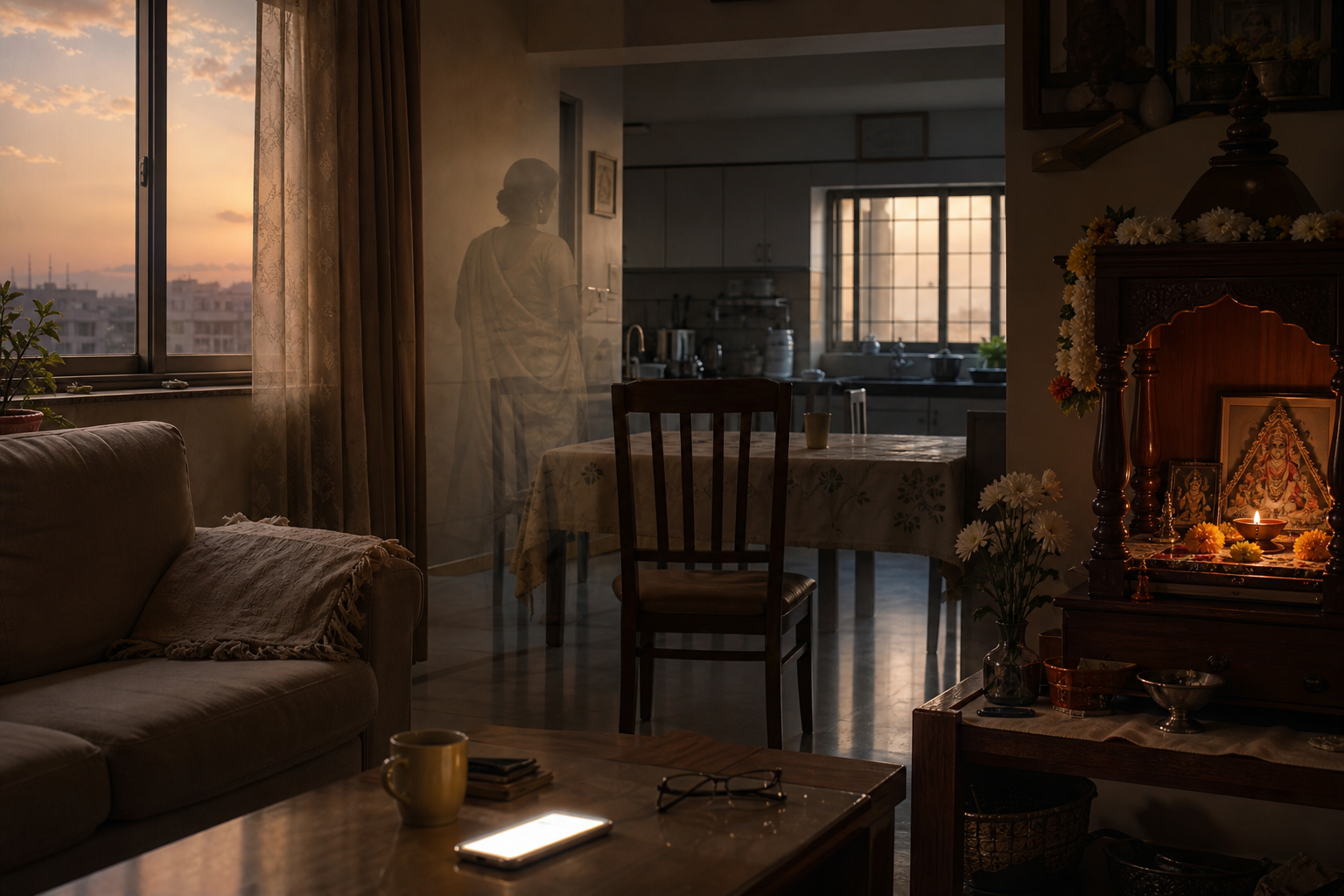
There are losses that arrive like storms.
And then there are losses that arrive so quietly that the silence they leave behind becomes louder than anything you’ve ever heard.
Today marks one month since our mother left us.
People say time heals. They say life moves on. They tell you to stay strong because that’s what mothers would want.
They’re probably right.
But no one tells you that the hardest part isn’t the day someone leaves.
It’s the ordinary days that follow.
The days when nothing special happens.
The days when you instinctively reach for your phone, expecting it to ring.
The days when you return home and, for a brief second, forget that no one is waiting to ask,
“Aaj kya khayega?”
My mother wasn’t someone who needed grand gestures to express love.
Love, for her, was routine.
A phone call at the same time every day.
Sometimes twice.
Sometimes three times.
Not because she had something important to say.
Just to ask,
“Khana kha liya?”
“Aaj kya khayega?”
“Tabiyat theek hai?”
Back then, those calls felt ordinary.
Today, I’d give anything to receive one more.
She worried about my health more than I ever did.
No matter how old I became, in her eyes I never stopped being someone who needed to eat on time, sleep properly, and take care of himself.
Maybe that’s what mothers do.
They continue protecting you long after you think you’ve become independent.
One sentence she often repeated has stayed with me ever since childhood.
“Tu bada hai na, samjha kar.”
At the time, it sounded like simple advice.
Today, it feels like an inheritance.
She wasn’t just asking me to be older.
She was asking me to be patient.
To understand.
To hold the family together.
To choose love over ego.
I don’t think I fully understood those words until she was gone.
If you visited our home, you would notice little things.
Everything had its place.
She liked the house clean.
She loved decorating the mandir.
Fresh flowers.
A neatly arranged diya.
The quiet devotion that never needed to be announced.
Faith, for her, wasn’t loud.
It was something she lived every single day.
My favorite meals still remind me of her.
Kadhi Chawal.
Besan ki Tikki ki Sabzi.
Simple Dal Chawal.
Funny how grief changes the meaning of food.
A meal isn’t just a recipe anymore.
It’s a memory.
It’s a conversation.
It’s love served on a plate.
The happiest version of my mother wasn’t when someone bought her gifts.
It wasn’t during festivals.
It wasn’t on birthdays.
She smiled the most when all of us were together.
When everyone was home.
When everyone was eating.
When everyone was laughing.
Her happiness was never about herself.
It was about seeing her family happy.
She left peacefully.
But far too suddenly.
She had been unwell.
Perhaps the coming days would have brought more suffering.
Maybe God was kinder to her than we were ready to understand.
That thought gives me some peace.
But acceptance doesn’t erase longing.
There are still mornings when I wake up hoping this has all been a bad dream.
There are evenings when I almost expect my phone to ring.
Sometimes, when I reach home after work, I still find myself looking for her.
Then reality quietly reminds me…
No one will ask,
“Office se aa gaya?”
“Khana kha le.”
People often say a house is made of bricks and walls.
I disagree.
A house is made of the person whose presence makes everyone feel they belong.
The walls are still here.
The doors are still here.
The furniture hasn’t moved.
The plants are still growing.
Everything looks the same.
And yet…
everything has changed.
Because the soul of this house is no longer visible.
It’s been one month.
Time has moved forward.
I am trying to do the same.
But grief doesn’t move in straight lines.
It hides inside ordinary moments.
Inside phone call timings.
Inside empty chairs.
Inside recipes.
Inside Mondays.
Inside the silence that follows every question no one asks anymore.
If there’s one thing my mother left behind, it isn’t just memories.
It’s the way she taught us to care.
To keep the family together.
To stay humble.
To understand before reacting.
To worry about the people we love.
To make a home feel like home.
And perhaps that’s why love never truly dies.
It simply changes its address.
Today, it lives inside all of us.
Miss you, Mummy.
No matter how many months or years pass, somewhere inside me, I’ll always be waiting for my phone to ring one more time…
“Kya hua? Itni der ho gayi… office nahi jana?”
A Thought Unfolded
A mother’s love rarely asks to be noticed. It quietly becomes the rhythm of everyday life—until one day, the rhythm is gone, and the silence teaches us what love truly sounded like.

Leave a Reply