Friday · 3 July 2026 Guayaquil 30°C Overcast Clouds

Category: Human Connection

  • Understanding Grief: A Mother’s Silent Love

    Understanding Grief: A Mother’s Silent Love

    There are losses that arrive like storms.

    And then there are losses that arrive so quietly that the silence they leave behind becomes louder than anything you’ve ever heard.

    Today marks one month since our mother left us.

    People say time heals. They say life moves on. They tell you to stay strong because that’s what mothers would want.

    They’re probably right.

    But no one tells you that the hardest part isn’t the day someone leaves.

    It’s the ordinary days that follow.

    The days when nothing special happens.

    The days when you instinctively reach for your phone, expecting it to ring.

    The days when you return home and, for a brief second, forget that no one is waiting to ask,

    “Aaj kya khayega?”


    My mother wasn’t someone who needed grand gestures to express love.

    Love, for her, was routine.

    A phone call at the same time every day.

    Sometimes twice.

    Sometimes three times.

    Not because she had something important to say.

    Just to ask,

    “Khana kha liya?”

    “Aaj kya khayega?”

    “Tabiyat theek hai?”

    Back then, those calls felt ordinary.

    Today, I’d give anything to receive one more.


    She worried about my health more than I ever did.

    No matter how old I became, in her eyes I never stopped being someone who needed to eat on time, sleep properly, and take care of himself.

    Maybe that’s what mothers do.

    They continue protecting you long after you think you’ve become independent.


    One sentence she often repeated has stayed with me ever since childhood.

    “Tu bada hai na, samjha kar.”

    At the time, it sounded like simple advice.

    Today, it feels like an inheritance.

    She wasn’t just asking me to be older.

    She was asking me to be patient.

    To understand.

    To hold the family together.

    To choose love over ego.

    I don’t think I fully understood those words until she was gone.


    If you visited our home, you would notice little things.

    Everything had its place.

    She liked the house clean.

    She loved decorating the mandir.

    Fresh flowers.

    A neatly arranged diya.

    The quiet devotion that never needed to be announced.

    Faith, for her, wasn’t loud.

    It was something she lived every single day.


    My favorite meals still remind me of her.

    Kadhi Chawal.

    Besan ki Tikki ki Sabzi.

    Simple Dal Chawal.

    Funny how grief changes the meaning of food.

    A meal isn’t just a recipe anymore.

    It’s a memory.

    It’s a conversation.

    It’s love served on a plate.


    The happiest version of my mother wasn’t when someone bought her gifts.

    It wasn’t during festivals.

    It wasn’t on birthdays.

    She smiled the most when all of us were together.

    When everyone was home.

    When everyone was eating.

    When everyone was laughing.

    Her happiness was never about herself.

    It was about seeing her family happy.


    She left peacefully.

    But far too suddenly.

    She had been unwell.

    Perhaps the coming days would have brought more suffering.

    Maybe God was kinder to her than we were ready to understand.

    That thought gives me some peace.

    But acceptance doesn’t erase longing.

    There are still mornings when I wake up hoping this has all been a bad dream.

    There are evenings when I almost expect my phone to ring.

    Sometimes, when I reach home after work, I still find myself looking for her.

    Then reality quietly reminds me…

    No one will ask,

    “Office se aa gaya?”

    “Khana kha le.”


    People often say a house is made of bricks and walls.

    I disagree.

    A house is made of the person whose presence makes everyone feel they belong.

    The walls are still here.

    The doors are still here.

    The furniture hasn’t moved.

    The plants are still growing.

    Everything looks the same.

    And yet…

    everything has changed.

    Because the soul of this house is no longer visible.


    It’s been one month.

    Time has moved forward.

    I am trying to do the same.

    But grief doesn’t move in straight lines.

    It hides inside ordinary moments.

    Inside phone call timings.

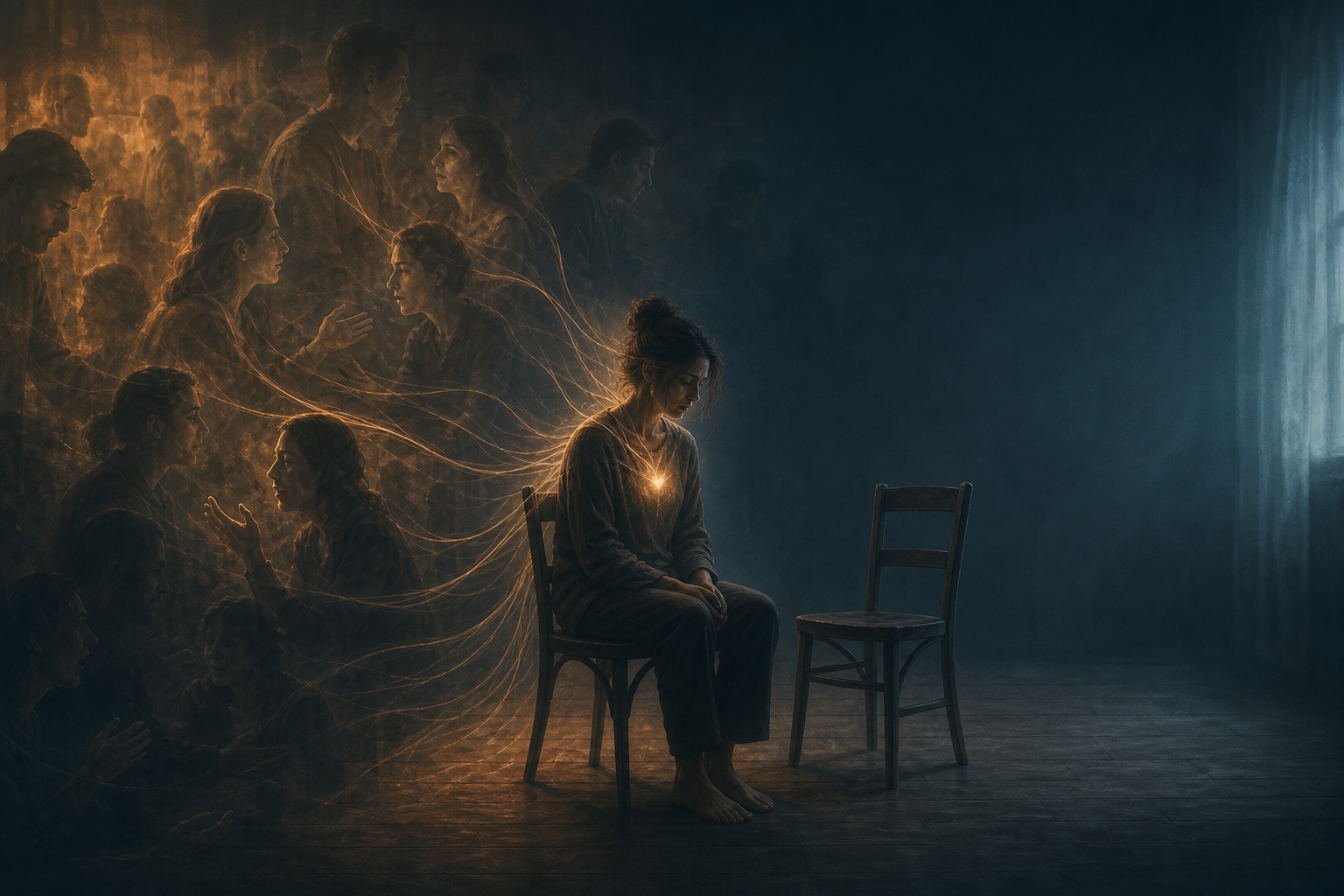
    Inside empty chairs.

    Inside recipes.

    Inside Mondays.

    Inside the silence that follows every question no one asks anymore.


    If there’s one thing my mother left behind, it isn’t just memories.

    It’s the way she taught us to care.

    To keep the family together.

    To stay humble.

    To understand before reacting.

    To worry about the people we love.

    To make a home feel like home.

    And perhaps that’s why love never truly dies.

    It simply changes its address.

    Today, it lives inside all of us.


    Miss you, Mummy.

    No matter how many months or years pass, somewhere inside me, I’ll always be waiting for my phone to ring one more time…

    “Kya hua? Itni der ho gayi… office nahi jana?”

    A Thought Unfolded
    A mother’s love rarely asks to be noticed. It quietly becomes the rhythm of everyday life—until one day, the rhythm is gone, and the silence teaches us what love truly sounded like.

  • Affairs Are Often About Newness, Not Dissatisfaction

    There’s a common belief that people have affairs because they are unhappy, frustrated, or irritated with their partners.
    But the truth is often more complicated than that.

    Many people who have affairs still love their partners.
    They still want them in their lives.
    They are not looking to replace them.

    So why does it happen?

    Because every time we meet someone new, a different part of us comes alive.

    With different people, we express different sides of our personality.
    Some sides feel playful.
    Some feel admired.
    Some feel deeply understood.
    And some feel free in ways they haven’t felt in a long time.

    In long-term relationships, this doesn’t mean love disappears.
    It means certain parts of who we are slowly stop being seen, used, or welcomed.
    Those parts don’t die — they just get parked somewhere inside us.

    When someone new enters our life and reflects one of those forgotten sides back to us, it feels powerful.
    It feels fresh.
    It feels like rediscovering yourself.

    That constant sense of newness — not anger or hatred toward a partner — is often what pulls people into affairs.

    This doesn’t make affairs right.
    Understanding a reason is not the same as justifying an action.

    But it does remind us of something important:

    People don’t always cheat because they want someone else.
    Sometimes they cheat because they miss a version of themselves.

    The real work, then, isn’t just about loyalty.
    It’s about awareness, communication, and creating space in relationships where all parts of a person are still allowed to breathe.

    A Thought Unfolded

    Love doesn’t disappear all at once.
    Sometimes, it stays — while curiosity wanders.

    Not toward another person,
    but toward another version of the self.

    What pulls us isn’t always desire.
    It’s the ache of feeling unfinished.

    And when someone new mirrors a forgotten part of us,
    it feels like meaning — even when it’s confusion.

    Understanding this doesn’t soften the damage.
    It only reminds us where the fracture truly begins.

  • This Body Is a Means, Not the End to Find Love

    We often believe the body is the destination.

    We spend so much time improving it, judging it, comparing it—thinking that love will arrive once we look a certain way or become more desirable. But slowly, life teaches something else.

    This body is not the end.
    It is only the means.

    It is the bridge that lets us experience emotions. It allows us to feel closeness, loss, longing, and warmth. But love itself does not live in skin or shape—it lives in connection.

    Real love is not found when a body is admired.
    It is found when a soul is understood.

    The body helps us express love—through presence, effort, care, and touch. But love grows in places the body cannot reach alone: patience, acceptance, emotional safety, and shared silence.

    Over time, the body changes.
    Energy fades.
    Appearances shift.

    But love, when it is real, does not shrink with time—it deepens.

    Maybe the purpose was never to perfect the body,
    but to use it well.
    To learn how to show up.
    To learn how to stay kind.
    To learn how to love without conditions.

    This body is a path.
    Love is the place it was always leading us to.

    And fate unfolds—not when we become flawless,
    But when we become honest.

    Thought Unfolded
    We chase love by fixing the surface,
    forgetting that love listens deeper.
    The body introduces us,
    but the soul is what stays.