Sunday · 30 August 2026 Mohali 34°C Scattered Clouds

Unfolding Fates

Navigating Love, Life, and the Unknown

Category: Mindfulness

  • What Does It Mean to Love a Country?

    What Does It Mean to Love a Country?

    Today, India celebrates its 80th Independence Day.

    Flags will rise, the anthem will play, and our screens will fill with messages of patriotism.

    But somewhere between all the celebration, there is a question worth asking:

    What does it actually mean to love your country?

    Does loving India mean agreeing with its government? Does patriotism require us to believe that everything happening around us is right?

    I don’t think so.

    Perhaps loving a country is a little like loving a person.

    When you truly love someone, you don’t become blind to their flaws. You can disagree with them, be disappointed in them, and still want the best for them.

    Sometimes, you question them because you care.

    A government is not a country.
    A political party is not a country.
    A policy is not a country.

    Governments will change. Leaders will come and go.

    The country remains.

    And a country isn’t merely the land beneath our feet.

    It is the people standing on it.

    People who speak different languages, worship differently, eat differently, vote differently and see the world differently.

    India was never meant to be a place where everyone thinks alike.

    Perhaps its beauty lies in something much harder:

    remaining together despite thinking differently.

    But there is another side of patriotism we don’t talk about enough.

    Loving a Country Is Also a Habit

    Patriotism is easy to express on Independence Day.

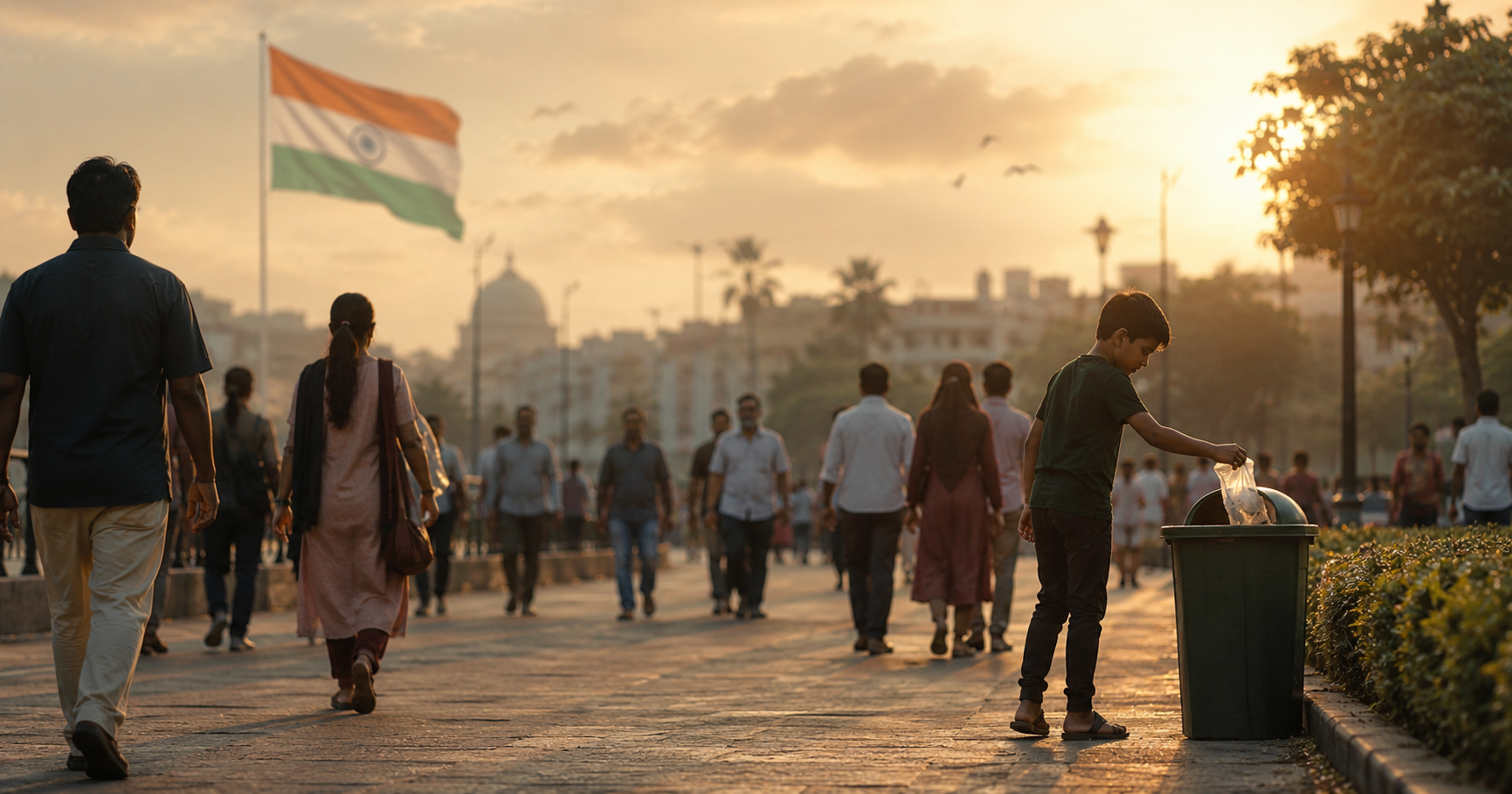
    Civic sense is how we express it on an ordinary Tuesday.

    Not throwing garbage on the road.

    Following traffic rules even when nobody is watching.

    Not damaging public property simply because it doesn’t belong to us personally.

    Standing in a queue.

    Keeping the volume down when others need peace.

    Treating public spaces as if they belong to us—

    because they actually do.

    We often expect the government to give us cleaner streets, better cities and a better country.

    And we should.

    But perhaps we should occasionally ask ourselves:

    What kind of citizens are we giving the country in return?

    Questioning the government and questioning ourselves are not opposite ideas.

    We need both.

    If something is broken, wanting it repaired isn’t hatred.

    If something is unfair, questioning it isn’t betrayal.

    But if we demand change while refusing to change our own everyday behaviour, something is missing too.

    Maybe patriotism isn’t only about what we feel when the national anthem plays.

    It is also what we do when nobody is looking.

    And perhaps brotherhood begins with something equally simple.

    Before someone becomes Hindu, Muslim, Sikh, Christian, left, right, rich or poor in our minds—

    they are another human being.

    And another Indian.

    Mazhab alag.
    Soch alag.
    Awaazein alag.
    Magar khwab ek — Hindustan.

    A Thought Unfolded
    Our ancestors gave us an independent India.
    Perhaps our responsibility is not merely to celebrate that freedom, but to become citizens worthy of it. To disagree without hatred.
    To question without abandoning.
    To demand better from our country—and from ourselves.
    To love our identity without diminishing someone else’s.
    Because a better India will not be built only in Parliament, courts or government offices.

    A little of it is built every day, by each of us.

    Not a perfect India.

    Our India. 🇮🇳

    Happy Independence Day.

  • Sometimes the Tone Isn’t in the Text

    Sometimes the Tone Isn’t in the Text

    Have you ever caught yourself overthinking text messages from someone you care about? Sometimes all it takes is a one-word reply:

    “Okay.”

    That’s it.

    And strangely, those four letters can mean completely different things depending on how you’re feeling when you read them.

    When everything feels good between you and that person, you barely notice it.

    Okay.

    You read it normally. Maybe they’re busy. Maybe there simply wasn’t anything more to say.

    But when something already feels different between you—when conversations have become shorter, replies take longer, or you’re quietly wondering where you stand—that same word suddenly changes.

    Okay.

    Why just okay?

    Are they upset?

    Did I say something wrong?

    Are they avoiding the conversation?

    Do they not want to talk to me anymore?

    Nothing about the message changed.

    But something inside you did.

    We Read More Than Words

    Text messages don’t come with facial expressions, body language, or tone of voice.

    So whenever a message is ambiguous, our mind has to fill in the missing pieces.

    And it often fills them with whatever we are already carrying.

    Security can make a short reply feel harmless.

    Anxiety can make it feel distant.

    Hurt can make it feel dismissive.

    Fear of losing someone can turn a completely ordinary message into evidence that something is wrong.

    The strange thing is that sometimes there is a change in the relationship. Sometimes our intuition is noticing a pattern before we consciously understand it.

    But sometimes there isn’t.

    Sometimes “okay” really means okay.

    The Message We Actually Read

    Perhaps this is why texting becomes so complicated in relationships that matter to us.

    We think we are reading someone’s words. Still, often we are also reading our history with them, their recent behaviour, our expectations, our insecurities, and the things we are afraid to ask directly.

    A message is written by one person.

    But its tone is sometimes created by two.

    The sender provides the words.

    The reader provides the emotional context.

    And somewhere between those two things, an entirely different conversation can happen—one that may never have existed in the sender’s mind at all.

    A Thought Unfolded
    We don’t just read texts. We read our relationships into them.

    Sometimes the coldness we hear is really there.
    Sometimes it comes from our own uncertainty.
    And perhaps the hardest part is knowing the difference.

  • Deluded Optimism Is the Only Way to Live

    Deluded Optimism Is the Only Way to Live

    Maybe optimism has always been a little delusional.

    We make plans knowing life can interrupt them.
    We trust people knowing they can disappoint us.
    We fall in love knowing people can leave.
    We start again knowing we might fail again.

    And somehow, every morning, we continue.

    We tell ourselves:

    Things will get better.
    This difficult phase will pass.
    Something good is waiting ahead.
    Maybe tomorrow will be different.

    But what proof do we really have?

    Sometimes, none.

    And perhaps that is exactly what makes optimism so powerful.

    Hope Rarely Comes With Evidence

    Pessimism has an advantage: it can always point to reality.

    People do leave.
    Relationships do break.
    Dreams do fail.
    Good people sometimes suffer for no reason.
    Life can change completely in a single day.

    Optimism looks at all of this and says:

    “Yes. But maybe something beautiful can still happen.”

    That maybe is important.

    It isn’t certainty.

    It isn’t a promise from the universe.

    Sometimes it’s nothing more than a story we tell ourselves so we can take one more step.

    And maybe we need that story.

    We Are All Betting on a Future We Cannot See

    Think about how much of life depends on believing in things that don’t exist yet.

    You work for a future you haven’t reached.

    You save money for years you aren’t guaranteed.

    You build relationships hoping they will last.

    You raise children believing they’ll find their own place in the world.

    You plant something today because you believe you’ll eventually sit beneath its shade.

    Almost everything meaningful requires some faith in tomorrow.

    If we calculated every possibility, every disappointment and every way things could go wrong before taking a step, many of us would never move at all.

    Sometimes logic tells us to protect ourselves.

    Optimism whispers:

    Try anyway.

    Maybe the Delusion Is Necessary

    Calling optimism delusional doesn’t necessarily mean ignoring reality.

    You can know exactly how difficult life is and still refuse to believe difficulty is the entire story.

    Perhaps the healthiest optimism isn’t:

    “Everything will be fine.”

    It’s:

    “Everything may not be fine, but something worth living for may still be ahead.”

    There is a difference.

    One denies reality.

    The other acknowledges reality and chooses hope anyway.

    And perhaps that’s the strange contradiction of being human.

    We know how temporary everything is, yet we become attached.

    We know hearts break, yet we love.

    We know people disappear, yet we make memories.

    We know there are no guarantees, yet we keep imagining tomorrow.

    Maybe that isn’t foolishness.

    Maybe that’s survival.

    A Thought Unfolded
    Perhaps we don’t remain optimistic because life gives us enough reasons to hope.
    Perhaps we remain optimistic because without a little unreasonable hope, life would become unbearably reasonable.
    So yes—
    Deluded optimism might just be the only way to live.
    Because sometimes you don’t need proof that something beautiful is coming.
    You just need enough hope to stay around and find out.

  • We Are the Music of Our Own Life

    We Are the Music of Our Own Life

    There are people who spend years waiting for life to sound perfect.

    They wait for the right job, the right relationship, the right moment, or the right version of themselves. They believe happiness begins when everything finally falls into place.

    But life doesn’t work that way.

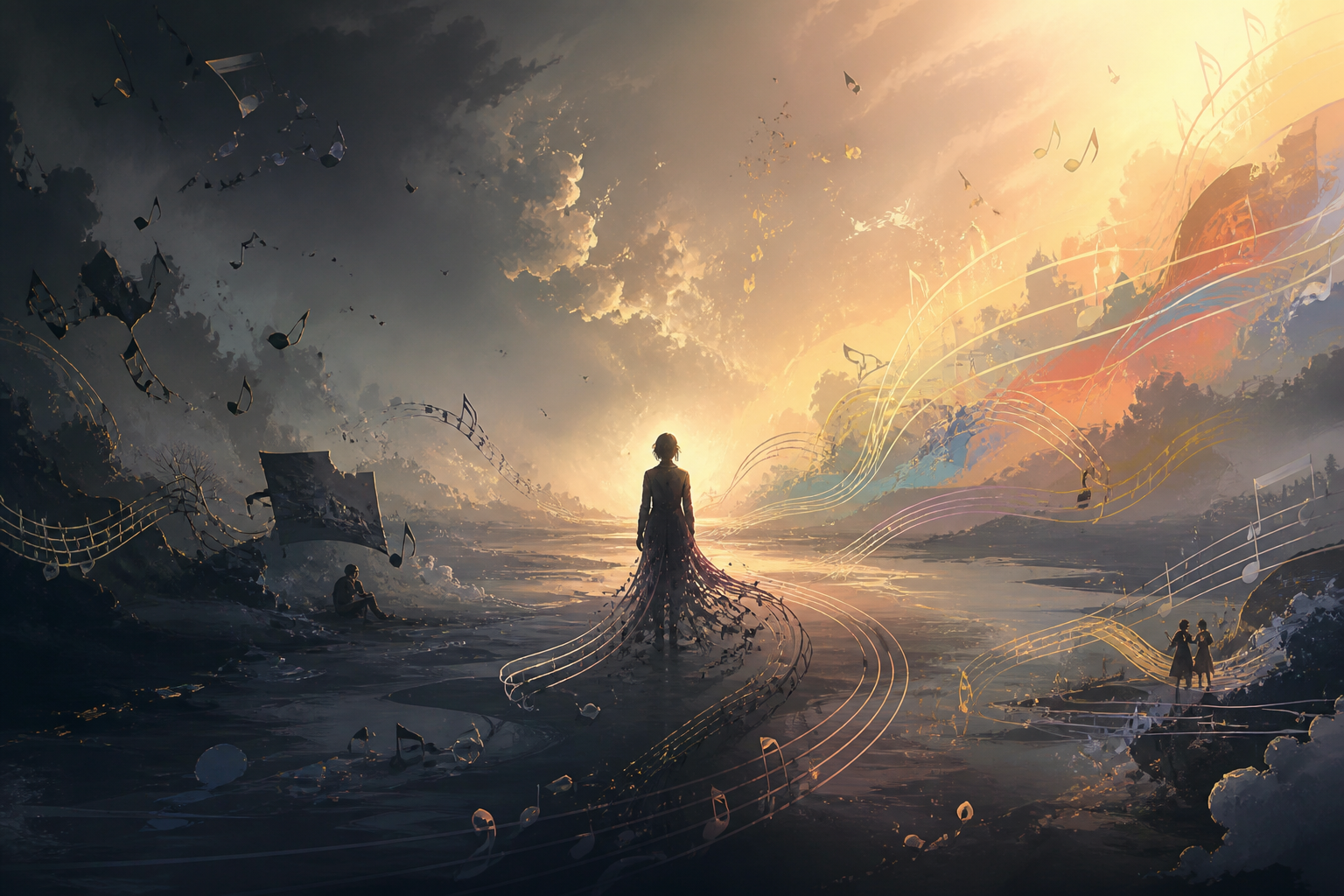
    We are the music of our own life.

    Every decision becomes a note. Every failure adds depth. Every heartbreak changes the rhythm. Every dream introduces a new melody. Even the pauses—the moments of uncertainty, grief, and silence—are not empty. They give meaning to everything that follows.

    No two lives sound the same.

    Some lives are loud with celebration. Others are gentle, slow, and reflective. Some carry the weight of sorrow before discovering hope. None of them are wrong. A melody doesn’t have to be perfect to be beautiful.

    The problem begins when we compare our music with someone else’s. Social media lets us hear only the highlights of other people’s songs while we continue living every unfinished verse of our own. We mistake their polished chorus for our ordinary days and forget that every masterpiece is built one note at a time.

    Perhaps the purpose of life isn’t to play the loudest song.

    Perhaps it is simply to create one that is true to who we are.

    So don’t be afraid of changing tempo. Don’t be ashamed of starting over. And don’t think that a quiet season means your music has ended.

    Some of the most unforgettable compositions begin with silence.

    Your story is still being written.

    Your melody is still unfolding.

    And no one else can create the music that only your life was meant to play.

    Because in the end, we are the music of our own life.

  • Dreams Evolve Too

    Dreams Evolve Too

    We often reach a point in life where we decide—

    This is my dream.
    This is who I want to become.
    This is where I want to be.

    And then we start running after it.

    We work hard, make plans, sacrifice things, and convince ourselves that reaching that dream is what success will look like.

    But while we are chasing our dreams, life keeps happening.

    Good things happen.
    Bad things happen.
    People enter our lives, and some leave.
    We gain things we once desperately wanted, only to realise they don’t mean as much anymore.

    And somewhere through all of this, we change.

    Our priorities change.
    Our definition of success changes.
    Sometimes ambition gives way to peace.
    Possessions give way to experiences.
    Recognition gives way to freedom.
    And sometimes, simply having time for the people we love starts feeling more valuable than everything we once wanted to achieve.

    Naturally, our dreams change too.

    And perhaps we shouldn’t always call that giving up.

    Because the person who dreamed that old dream may no longer be the person we are today.

    Maybe life isn’t about staying loyal to every dream we once had.

    Maybe, every once in a while, we need to ask ourselves—

    “The dream I am still chasing… is it still mine?”

    Dreams don’t always break.

    Sometimes, they simply evolve with us.

    A Thought Unfolded
    Sometimes we don’t give up on our dreams—
    we simply outgrow them.
    The harder part is giving ourselves permission to want something different.

  • The Empathy–Isolation Paradox: When Understanding Everyone Leaves You Alone

    The Empathy–Isolation Paradox: When Understanding Everyone Leaves You Alone

    There is a strange kind of loneliness that doesn’t come from having no one around.

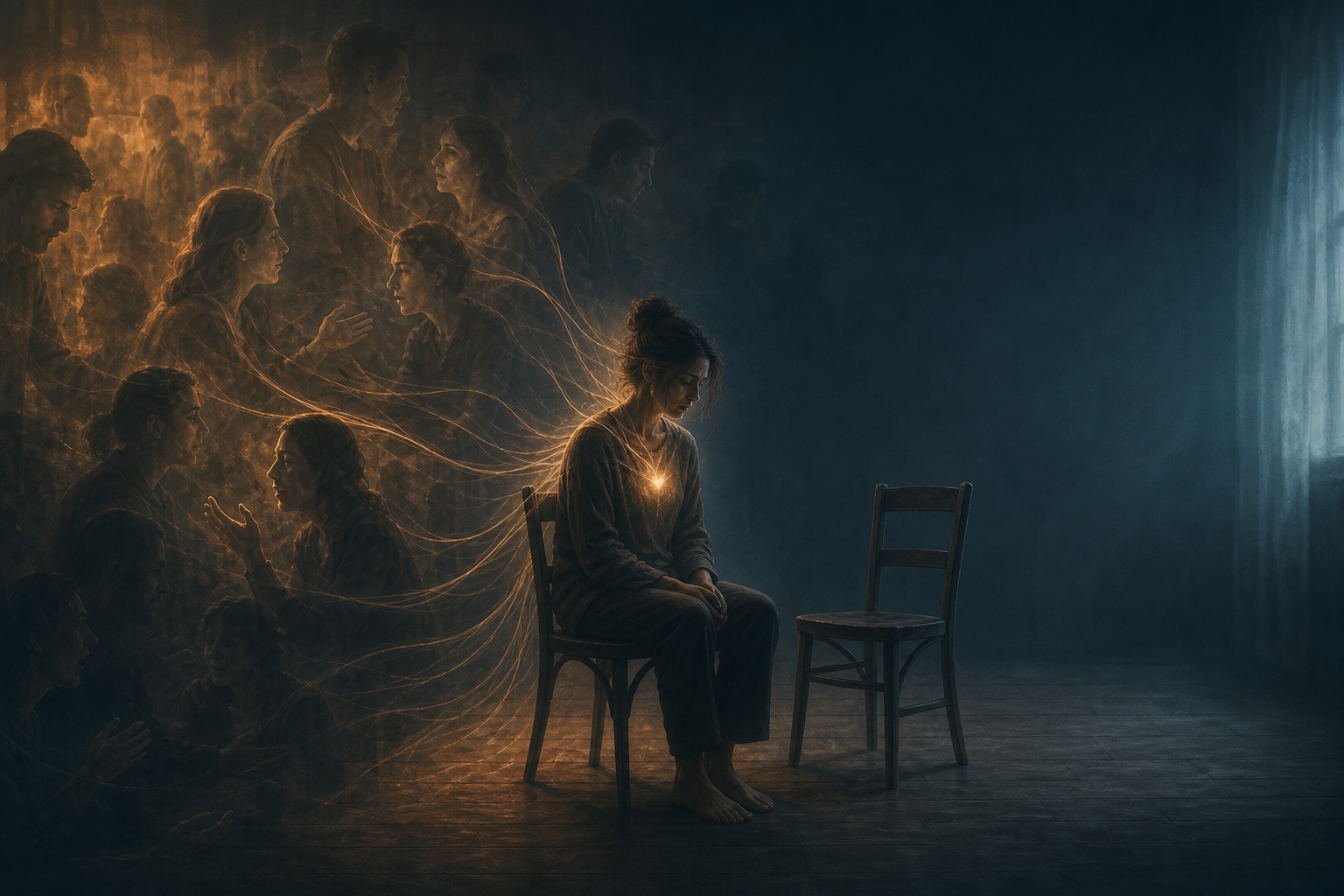
    It comes from understanding everyone around you, while rarely feeling understood yourself.

    Maybe that is the empathy–isolation paradox.

    You understand why someone was rude.

    Maybe they were having a terrible day.

    You understand why someone disappeared.

    Maybe they were fighting battles they never told you about.

    You understand why someone couldn’t love you the way you needed.

    Maybe they simply never learned how.

    So you forgive.

    You adjust.

    You give another chance.

    You tell yourself—

    “There must be a reason.”

    And perhaps there is.

    But somewhere between understanding everyone’s reasons and forgiving everyone’s behaviour, something quietly happens:

    Your own feelings stop getting a seat at the table.

    You become the person people come to when life becomes heavy.

    You listen.

    You notice what they don’t say.

    You understand the silence between their words.

    But when your own world becomes heavy, you sometimes discover something uncomfortable:

    Not everyone knows how to sit with your silence.

    And that hurts differently.

    Because empathy creates connection, but deep empathy can also create isolation when it constantly flows in only one direction.

    Perhaps the answer isn’t to become less empathetic.

    Perhaps it is simply to remember that understanding someone does not require abandoning yourself.

    You can understand why someone hurt you and still admit that they hurt you.

    You can understand their circumstances

    and still have boundaries.

    You can forgive someone

    without giving them unlimited access to your life.

    Empathy should make us more human.

    It should not make us invisible.

    And maybe growing up emotionally means learning one difficult truth:

    You deserve the same understanding you so easily give to everyone else.

    A Thought Unfolded
    Sometimes loneliness is not the absence of people.
    It is the absence of someone who understands you the way you have always tried to understand everyone else.

  • Understanding Grief: A Mother’s Silent Love

    Understanding Grief: A Mother’s Silent Love

    There are losses that arrive like storms.

    And then there are losses that arrive so quietly that the silence they leave behind becomes louder than anything you’ve ever heard.

    Today marks one month since our mother left us.

    People say time heals. They say life moves on. They tell you to stay strong because that’s what mothers would want.

    They’re probably right.

    But no one tells you that the hardest part isn’t the day someone leaves.

    It’s the ordinary days that follow.

    The days when nothing special happens.

    The days when you instinctively reach for your phone, expecting it to ring.

    The days when you return home and, for a brief second, forget that no one is waiting to ask,

    “Aaj kya khayega?”


    My mother wasn’t someone who needed grand gestures to express love.

    Love, for her, was routine.

    A phone call at the same time every day.

    Sometimes twice.

    Sometimes three times.

    Not because she had something important to say.

    Just to ask,

    “Khana kha liya?”

    “Aaj kya khayega?”

    “Tabiyat theek hai?”

    Back then, those calls felt ordinary.

    Today, I’d give anything to receive one more.


    She worried about my health more than I ever did.

    No matter how old I became, in her eyes I never stopped being someone who needed to eat on time, sleep properly, and take care of himself.

    Maybe that’s what mothers do.

    They continue protecting you long after you think you’ve become independent.


    One sentence she often repeated has stayed with me ever since childhood.

    “Tu bada hai na, samjha kar.”

    At the time, it sounded like simple advice.

    Today, it feels like an inheritance.

    She wasn’t just asking me to be older.

    She was asking me to be patient.

    To understand.

    To hold the family together.

    To choose love over ego.

    I don’t think I fully understood those words until she was gone.


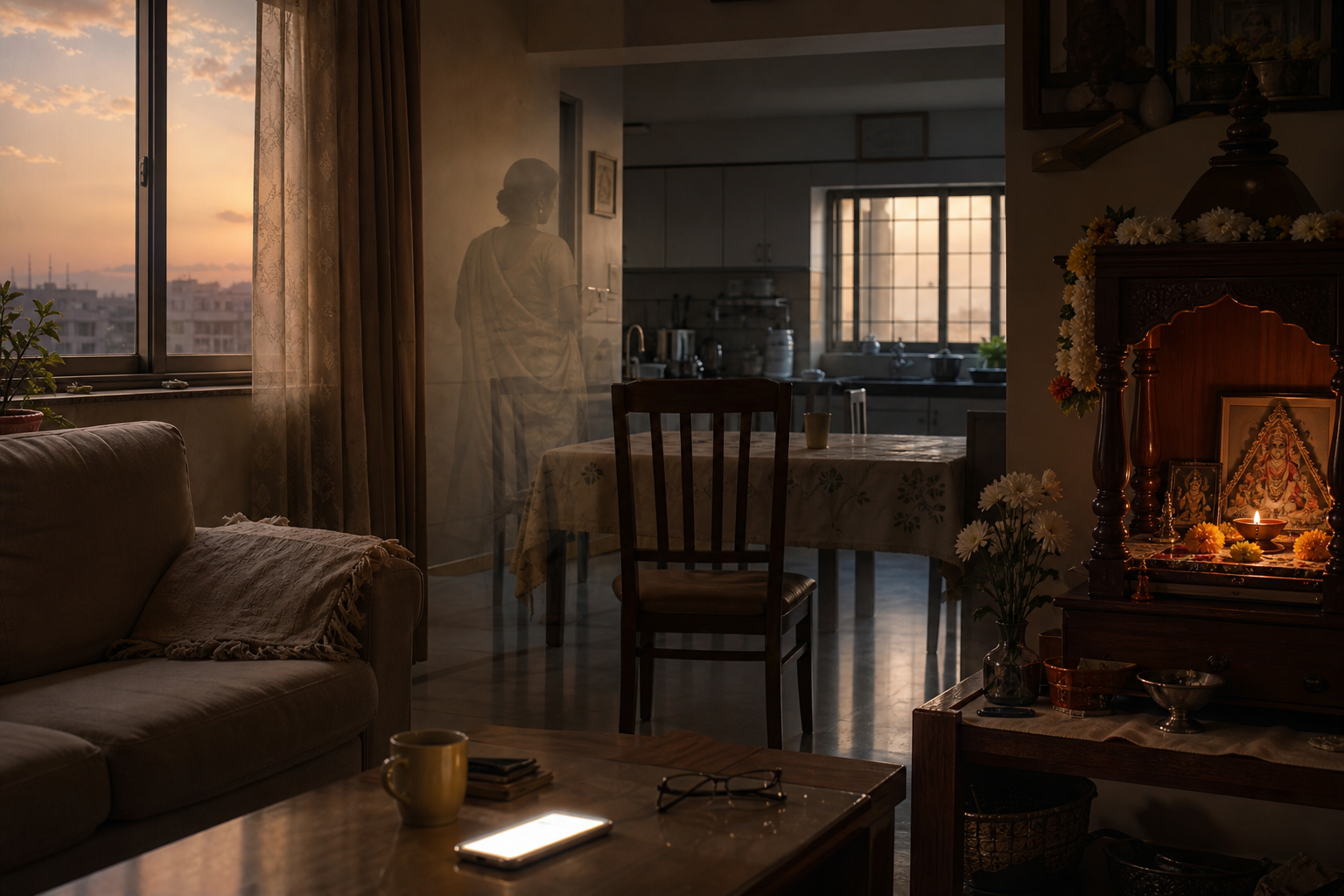
    If you visited our home, you would notice little things.

    Everything had its place.

    She liked the house clean.

    She loved decorating the mandir.

    Fresh flowers.

    A neatly arranged diya.

    The quiet devotion that never needed to be announced.

    Faith, for her, wasn’t loud.

    It was something she lived every single day.


    My favorite meals still remind me of her.

    Kadhi Chawal.

    Besan ki Tikki ki Sabzi.

    Simple Dal Chawal.

    Funny how grief changes the meaning of food.

    A meal isn’t just a recipe anymore.

    It’s a memory.

    It’s a conversation.

    It’s love served on a plate.


    The happiest version of my mother wasn’t when someone bought her gifts.

    It wasn’t during festivals.

    It wasn’t on birthdays.

    She smiled the most when all of us were together.

    When everyone was home.

    When everyone was eating.

    When everyone was laughing.

    Her happiness was never about herself.

    It was about seeing her family happy.


    She left peacefully.

    But far too suddenly.

    She had been unwell.

    Perhaps the coming days would have brought more suffering.

    Maybe God was kinder to her than we were ready to understand.

    That thought gives me some peace.

    But acceptance doesn’t erase longing.

    There are still mornings when I wake up hoping this has all been a bad dream.

    There are evenings when I almost expect my phone to ring.

    Sometimes, when I reach home after work, I still find myself looking for her.

    Then reality quietly reminds me…

    No one will ask,

    “Office se aa gaya?”

    “Khana kha le.”


    People often say a house is made of bricks and walls.

    I disagree.

    A house is made of the person whose presence makes everyone feel they belong.

    The walls are still here.

    The doors are still here.

    The furniture hasn’t moved.

    The plants are still growing.

    Everything looks the same.

    And yet…

    everything has changed.

    Because the soul of this house is no longer visible.


    It’s been one month.

    Time has moved forward.

    I am trying to do the same.

    But grief doesn’t move in straight lines.

    It hides inside ordinary moments.

    Inside phone call timings.

    Inside empty chairs.

    Inside recipes.

    Inside Mondays.

    Inside the silence that follows every question no one asks anymore.


    If there’s one thing my mother left behind, it isn’t just memories.

    It’s the way she taught us to care.

    To keep the family together.

    To stay humble.

    To understand before reacting.

    To worry about the people we love.

    To make a home feel like home.

    And perhaps that’s why love never truly dies.

    It simply changes its address.

    Today, it lives inside all of us.


    Miss you, Mummy.

    No matter how many months or years pass, somewhere inside me, I’ll always be waiting for my phone to ring one more time…

    “Kya hua? Itni der ho gayi… office nahi jana?”

    A Thought Unfolded
    A mother’s love rarely asks to be noticed. It quietly becomes the rhythm of everyday life—until one day, the rhythm is gone, and the silence teaches us what love truly sounded like.

  • Knowledge Cancels Fear

    Knowledge Cancels Fear

    Fear often feels loud, overwhelming, and absolute.
    But most fear doesn’t come from reality — it comes from the unknown.

    Knowledge doesn’t promise certainty.
    It doesn’t erase every doubt.
    What it does is quieter, stronger, and more lasting.

    Knowledge replaces imagination with understanding.
    It turns shadows into shapes, questions into clarity.
    When you learn, fear loses its power to exaggerate.
    What once felt threatening becomes something you can observe, name, and face.

    We are rarely afraid of what we truly understand.
    We are afraid of what we haven’t looked at closely yet.

    Growth begins the moment curiosity becomes stronger than fear.

    A Thought Unfolded
    Fear lives where awareness hasn’t reached yet.
    Knowledge doesn’t make us fearless —
    It makes us brave enough to stay present.