
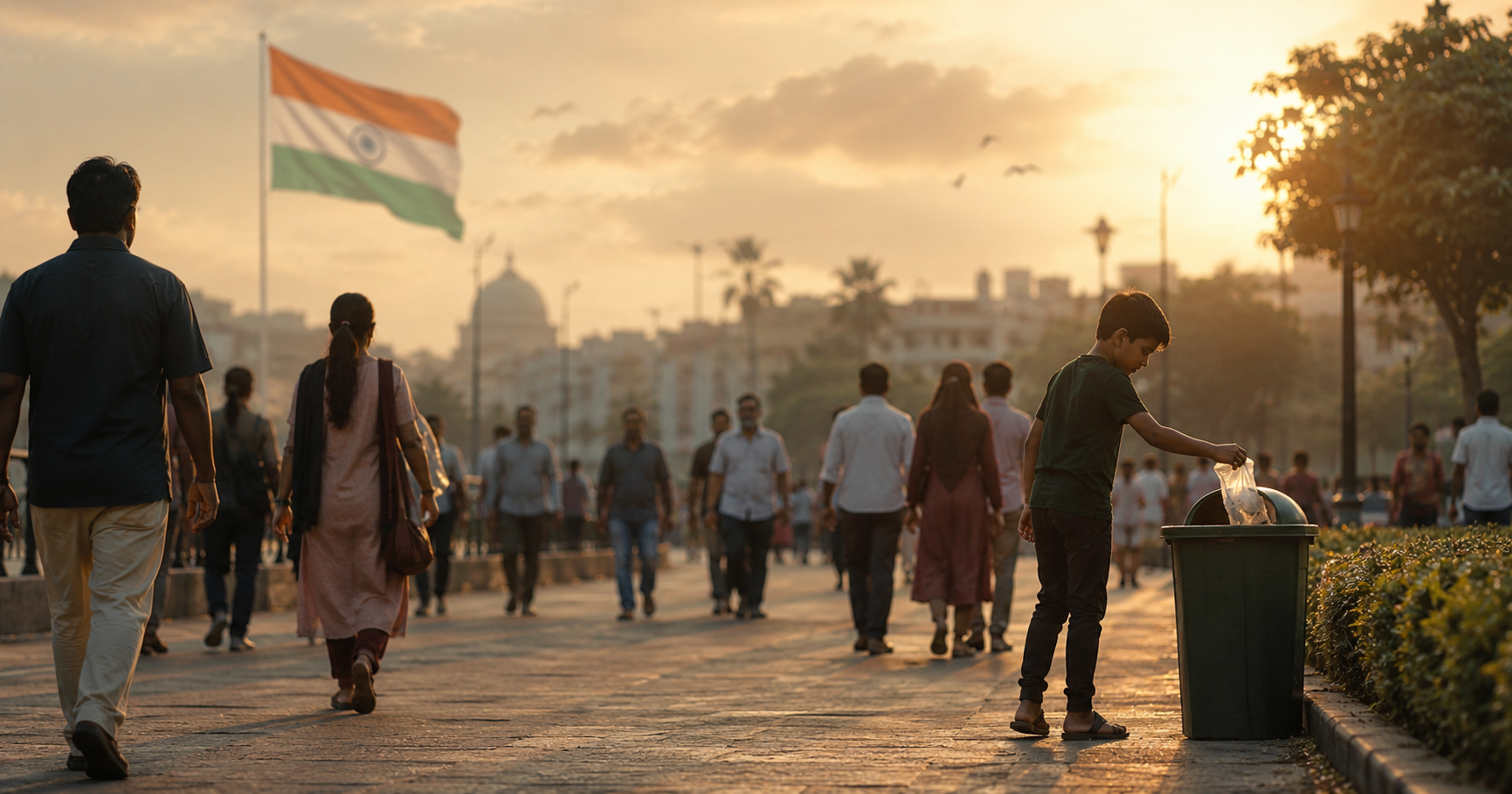
Today, India celebrates its 80th Independence Day.
Flags will rise, the anthem will play, and our screens will fill with messages of patriotism.
But somewhere between all the celebration, there is a question worth asking:
What does it actually mean to love your country?
Does loving India mean agreeing with its government? Does patriotism require us to believe that everything happening around us is right?
I don’t think so.
Perhaps loving a country is a little like loving a person.
When you truly love someone, you don’t become blind to their flaws. You can disagree with them, be disappointed in them, and still want the best for them.
Sometimes, you question them because you care.
A government is not a country.
A political party is not a country.
A policy is not a country.
Governments will change. Leaders will come and go.
The country remains.
And a country isn’t merely the land beneath our feet.
It is the people standing on it.
People who speak different languages, worship differently, eat differently, vote differently and see the world differently.
India was never meant to be a place where everyone thinks alike.
Perhaps its beauty lies in something much harder:
remaining together despite thinking differently.
But there is another side of patriotism we don’t talk about enough.
Loving a Country Is Also a Habit
Patriotism is easy to express on Independence Day.
Civic sense is how we express it on an ordinary Tuesday.
Not throwing garbage on the road.
Following traffic rules even when nobody is watching.
Not damaging public property simply because it doesn’t belong to us personally.
Standing in a queue.
Keeping the volume down when others need peace.
Treating public spaces as if they belong to us—
because they actually do.
We often expect the government to give us cleaner streets, better cities and a better country.
And we should.
But perhaps we should occasionally ask ourselves:
What kind of citizens are we giving the country in return?
Questioning the government and questioning ourselves are not opposite ideas.
We need both.
If something is broken, wanting it repaired isn’t hatred.
If something is unfair, questioning it isn’t betrayal.
But if we demand change while refusing to change our own everyday behaviour, something is missing too.
Maybe patriotism isn’t only about what we feel when the national anthem plays.
It is also what we do when nobody is looking.
And perhaps brotherhood begins with something equally simple.
Before someone becomes Hindu, Muslim, Sikh, Christian, left, right, rich or poor in our minds—
they are another human being.
And another Indian.
Mazhab alag.
Soch alag.
Awaazein alag.
Magar khwab ek — Hindustan.
A Thought Unfolded
Our ancestors gave us an independent India.
Perhaps our responsibility is not merely to celebrate that freedom, but to become citizens worthy of it. To disagree without hatred.
To question without abandoning.
To demand better from our country—and from ourselves.
To love our identity without diminishing someone else’s.
Because a better India will not be built only in Parliament, courts or government offices.
A little of it is built every day, by each of us.
Not a perfect India.
Our India. 🇮🇳

Leave a Reply