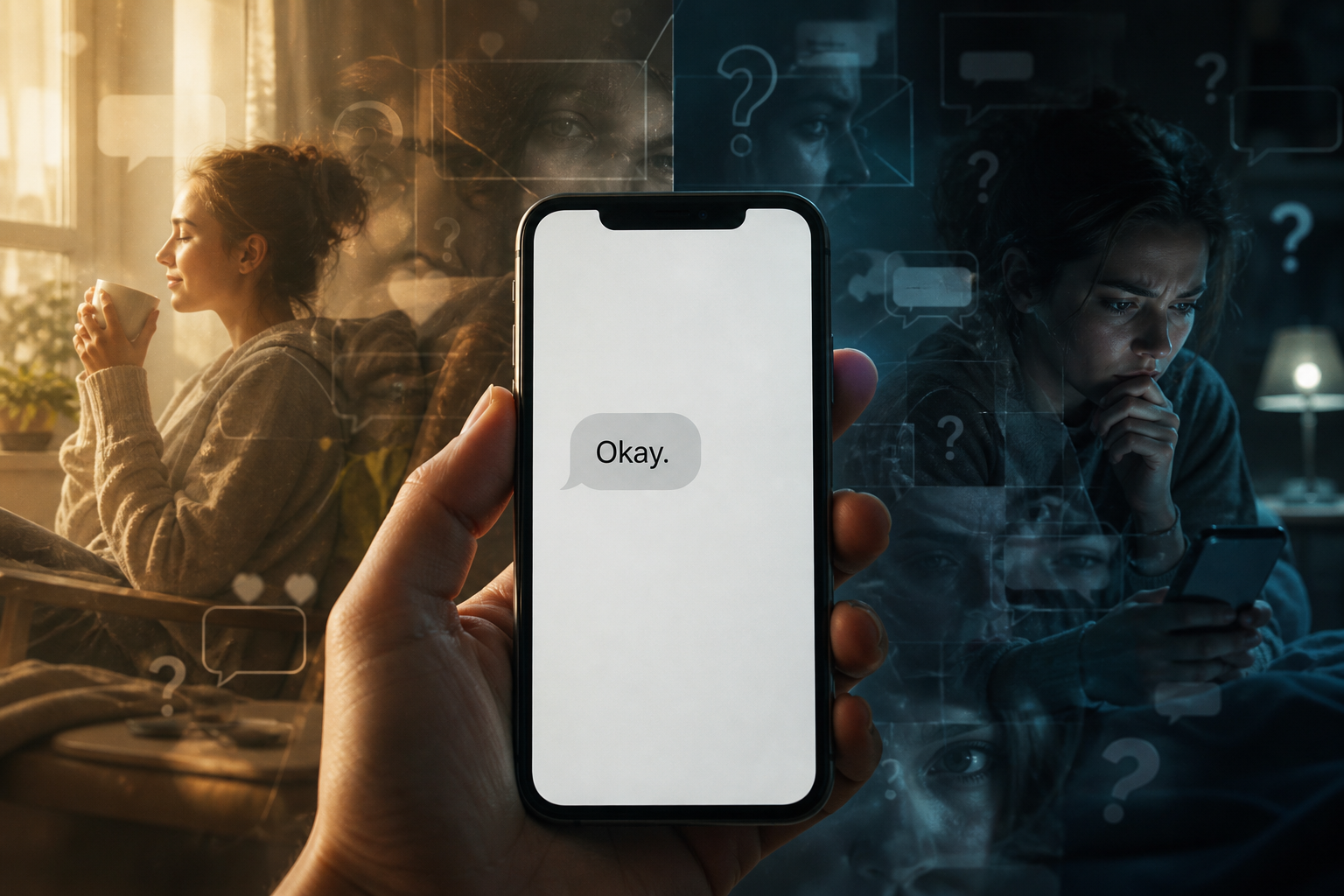
Have you ever caught yourself overthinking text messages from someone you care about? Sometimes all it takes is a one-word reply:
“Okay.”
That’s it.
And strangely, those four letters can mean completely different things depending on how you’re feeling when you read them.
When everything feels good between you and that person, you barely notice it.
Okay.
You read it normally. Maybe they’re busy. Maybe there simply wasn’t anything more to say.
But when something already feels different between you—when conversations have become shorter, replies take longer, or you’re quietly wondering where you stand—that same word suddenly changes.
Okay.
Why just okay?
Are they upset?
Did I say something wrong?
Are they avoiding the conversation?
Do they not want to talk to me anymore?
Nothing about the message changed.
But something inside you did.
We Read More Than Words
Text messages don’t come with facial expressions, body language, or tone of voice.
So whenever a message is ambiguous, our mind has to fill in the missing pieces.
And it often fills them with whatever we are already carrying.
Security can make a short reply feel harmless.
Anxiety can make it feel distant.
Hurt can make it feel dismissive.
Fear of losing someone can turn a completely ordinary message into evidence that something is wrong.
The strange thing is that sometimes there is a change in the relationship. Sometimes our intuition is noticing a pattern before we consciously understand it.
But sometimes there isn’t.
Sometimes “okay” really means okay.
The Message We Actually Read
Perhaps this is why texting becomes so complicated in relationships that matter to us.
We think we are reading someone’s words. Still, often we are also reading our history with them, their recent behaviour, our expectations, our insecurities, and the things we are afraid to ask directly.
A message is written by one person.
But its tone is sometimes created by two.
The sender provides the words.
The reader provides the emotional context.
And somewhere between those two things, an entirely different conversation can happen—one that may never have existed in the sender’s mind at all.
A Thought Unfolded
We don’t just read texts. We read our relationships into them.
Sometimes the coldness we hear is really there.
Sometimes it comes from our own uncertainty.
And perhaps the hardest part is knowing the difference.